Showing posts with label Mark McClain. Show all posts

Friday, November 2, 2018

"To Err Is Human," by Mark McClain

Constructor's Comments

Happy Birthday to Me!  I am living proof that "To Err Is Human" . . . witness today's puzzle.  Some people believe crosswords should steer clear of the negative side of life, but how can that be possible when we English speakers have so very many words for PROBLEM?  A few of these are highlighted in this puzzle's four theme entries, though they are clued as if there is no PROBLEM at all.  But of course there is a PROBLEM (see 40-Across).  Hats off once again to David, who found a glitch in one of my theme entries (GLITCH being another PROBLEM word and a rhymer for HITCH).  David also suggested the inclusion of typos in the clues to add a little humor (with apologies to the spellcheck police, who were likely appalled by this gimmick and consider both David and I to be morons).  So in closing let me just say that if you finished this puzzle, then you definitely have a PROBLEM!


Friday, October 26, 2018

"Crossbreed," by Mark McClain

Constructor's Comments

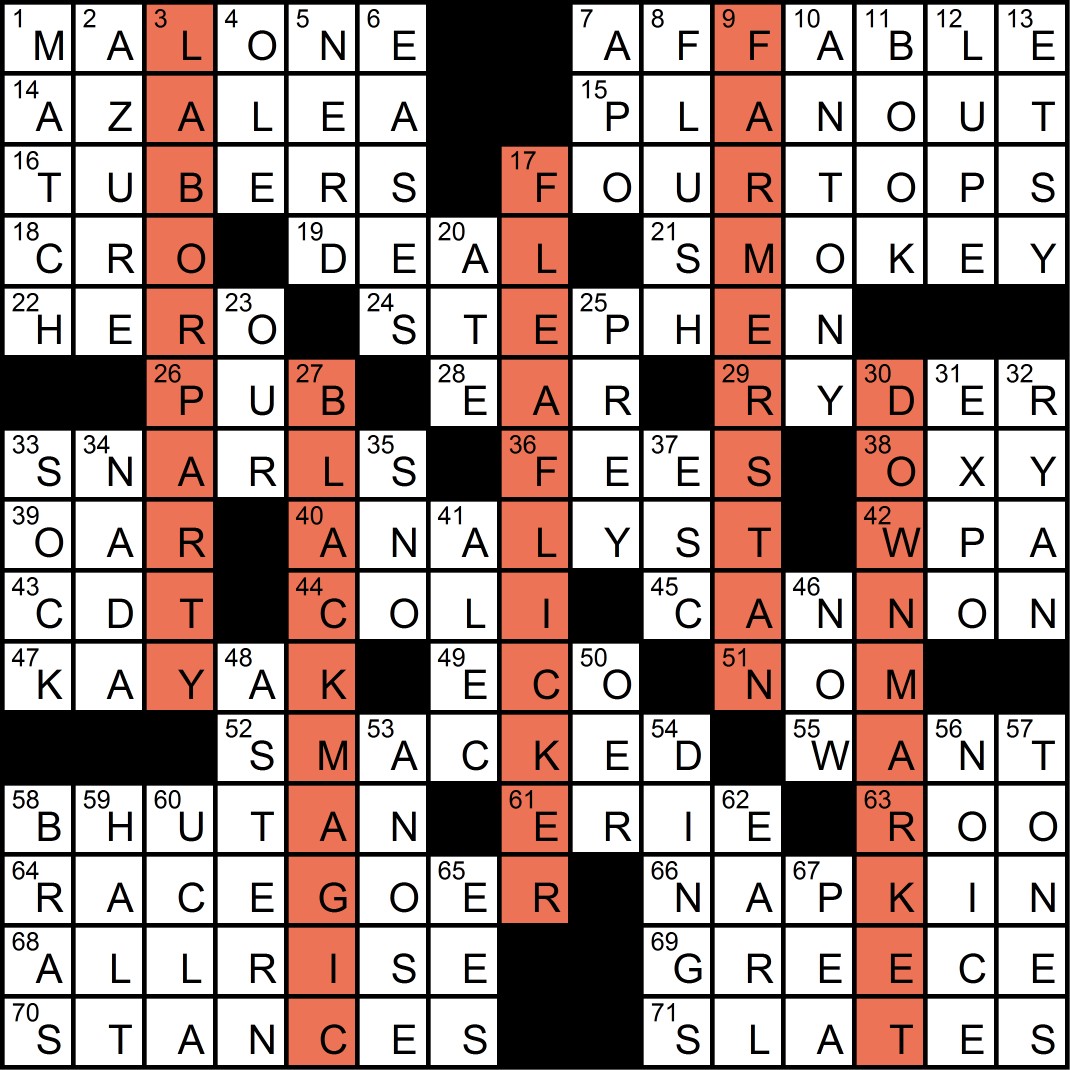
If you're familiar with the word rebus, you may know that its dictionary definition is a puzzle device that uses pictures to represent words or letters.  But in the world of crosswords, the term is used to describe a puzzle with squares that contain more than one letter.  That's what we have today, and to add another layer of silliness to it, the squares that contain these letters are all black.  So, you can't write the letters in, which is just as well, because it's a pain in the neck to write a bunch of letters in those little squares, and if you're doing it on your screen, it may be even harder or impossible.  Anyway, the letters represented by the black squares are combined with the letters to the right and left to make sense of the clue.  In this puzzle the word that goes in those black squares is (not by accident) something that goes with black, which is all revealed near the bottom of the puzzle by the adjacent entries BLACK and LABS.  Bow-wow.

This is a departure from my usual puzzle-making technique, which is to stick to fairly basic themes and confine the trickery to an occasional pun or deceptive clue or two.


Monday, October 15, 2018

"Homespun Fun," by Mark McClain

Constructor's Comments

This type of theme is known as a "chain" or "shared center."  The first and second words of each theme entry form a familiar phrase, and the second and third words also form a familiar phrase (which has nothing to do with the first phrase).  So the two outer words "share" the center word.  This type of theme is somewhat out of fashion with editors (as David mentioned to me in his acceptance message).  This one escaped rejection because it has two elements that are not always seen in such themes:  1) The theme entries are related (the first two-word phrase is a household item), and 2) the entries are humorously clued as if the whole three-word set is a thing, thus turning it into a pun, which could be considered the "subtheme" of the puzzle.


Thursday, August 16, 2018

"Take It Down a Notch," by Mark McClain

Constructor's Comments

The inspiration for this theme was the book Three Men in a Boat.  It's a humorous novel/travelogue (published in 1889) about a two-week rowboat trip on the River Thames from Kingston upon Thames (near London) to Oxford and back.  This was of great interest to me because a few years ago my partner, Diana, and I undertook a 125-mile, two-week backpacking trip on the Thames Path from the source of the river to Windsor (where the queen lives, just outside London).  We covered quite a bit of the same territory and even saw a few of the same type of boat (three-person rowboat) that was used in Jerome's book (one person does the steering, the other two do the rowing).  I heartily recommend this book to anyone who's interested in English culture or boating, but I strongly discourage eating off the floor anywhere that a four-second rule is in force.

Tuesday, July 31, 2018

"Bear's Delight," by Mark McClain

Constructor's Comments

It occurred to me recently that there are people in college today who may not be able to relate to a Wall Street slump (see 30-Down).  We're on the verge of experiencing the longest bull market in history—nearly ten years!  So in today's puzzle we give the "bears" the microphone, and they explain that it really is possible for markets to go DOWN.  But they make it a little tricky, because it's only the first words of four long answers that are a kind of market . . . and they're paired with words that make phrases that have nothing to do with markets (nor do those kinds of markets have anything to do with Wall Street, but it's all in good fun).


Editor's Comments

Mark always makes such smooth puzzles!  The reveal DOWN MARKET nicely describes what's going on, and all the theme entries feel fresh as well.  Mark could have added one extra pair (or even two) of black squares in the upper right and lower left, but I like how he pushed himself to keep the word count low while at the same time keeping the short fill smooth.  Midlength entries like FOUR TOPS, SMOKEY, BHUTAN, RACEGOER, and ALL RISE make the solve much more interesting than if there were a bunch of three- and four-letter words in those corners.

Friday, July 20, 2018

"Compression Chamber," by Mark McClain

Constructor's Comments

This puzzle is based on what might be called a "shared letters" theme.  The four long entries are familiar three-word phrases in which the last letter of the first two words is the same as the first letter of the following word, and these letters are "shared" in the grid.  This may create some consternation on the part of solvers who might think there is an error in the grid . . . until they figure out the gimmick, which hopefully doesn't take too long.  Once you've finished the grid, you may notice that if you read the phrases, they seem perfectly normal.  Or not.


Editor's Comments

They say sharing is caring, though Mark found an ingenious way to turn sharing into a fiendish Friday theme!  Finding four in-the-language three-word phrases with double letters at each word break can't have been easy to do.  And just overall, I love the quirkiness and originality of the theme.  In the fill, you'll notice that there are no long nonthematic downs.  I think that was a good choice on Mark's part, since having long nonthematic downs mixed in with the long down theme entries might have been confusing.  Focusing more on midlength slots also allowed Mark to keep the fill extra-smooth.

Friday, June 8, 2018

"Half Off," by Mark McClain

Constructor's Comments

English is so colorful, brimming with idiomatic terms that often "puzzle" people who are trying to learn it as a second language.  Of course, other languages have their own idiomatic terms—for example, in Spanish "encontrar tu media naranja" means literally "to find your half of an orange."  But what it really means is to find your true love or, as we might say in English, your better "half."

So, today we explore English phrases that include the word "half."  We crossword-making folk are not allowed to use the same word over and over in a puzzle grid, but we can in the clues!  But, to make it a little tougher, let's leave the key word out altogether.  So, all the HALF phrases in the clues are missing the word HALF.  Thankfully, we have a title that helps you figure all that out.

And finally, you perfectionists out there might have picked up on the fact that only four of the five phrases are idiomatic.  A FIFTY-CENT PIECE is literally half of a dollar—but then I'm sure many solvers are scratching their heads wondering what a fifty-cent is!  Ask your grandma.


Editor's Comments

Mark put a clever twist on the classic definition theme.  I also appreciate the extra care he took to make sure the theme entries were in-the-language.  Interestingly, when I was growing up, I always called half-dollars FIFTY-CENT PIECEs.  Maybe that's just me, though—I'd be interested to hear more perspectives in the comments.  In any case, working around five theme entries—especially when two are 14 letters long—is always a challenge.  Mark kept the fill extra-smooth, though, in part by sectioning off the different corners.  In theme-dense puzzles like this one, that can be a smart strategy, since working in long downs often forces many compromises.